
How to Reduce Heat in Singapore Homes Using Curtains

By Last Updated: April 27th, 2026

Living in Singapore, we all face the same problem. Your home starts feeling like a greenhouse by late afternoon. And the only quick fix would be to turn on your aircon. BUT! The good news is that with the right curtains, you can significantly reduce heat and keep your home cooler while lowering energy usage.

This guide will explain why Singapore homes trap heat, how curtains can reduce heat and what types of fabric work best for our hot weather.

Why Singapore Homes Trap Heat

1. West Sun and Strong Solar Gain

full width living room day curtains

According to Energy Market Authority, Singapore is one of the most solar-dense cities in the world. Being located close to the equator, we experience high solar radiation and high humidity. When late-afternoon sun hits between 3pm to 7pm, it creates an intense cumulative heat.

2. Concrete Heat Retention

With our housing walls being made with concrete, which is a poor to moderate conductor of it, it absorbs, stores and radiates heat over time.

In the early to mid afternoon, our homes would feel cooling because the concrete has had time to cool down over the night before the sun comes up again. This helps to cool down the room. Over the day, the concrete walls start to absorb the heat.

By evening, your walls would have gathered the heat so your room will continue to stay warm while releasing the heat. This is why your home still feels hot long after sunset. Combine this with high levels of humidity, you would feel hot and stuffy even when the temperature outside of your home has dropped.

Curtains that block or reflect sun through your windows especially when you have large window panes can interrupt this heat absorption and help reduce heat in your home more effectively.

3. High‑Rise, Windows & Area

High-rise buildings, large window panels, and living near large body of water are factors that can affect the heat in your home.

Living in high-rise HDB or condo unit can expose your home to direct solar radiation and also heat transfer from the roof if you are living on the top floor. You may also think that it would be windy living at higher levels, but be ware that the winds that enter could also be hot because hot air rises. And your home would be dusty.

Large window panes can give you a stunning view but it also increases the area where heat can enter. Without proper shading, the windows can turn your home into a greenhouse.

Living near large body of water will also add to the heat you feel in your home. When there is water, there will be higher humidity because there’ll always be moisture in the air due to evaporation.

Do Curtains Actually Reduce Heat?

Yes. When you choose the right type of curtains, they can act as a thermal layer at your windows.

How Curtains Work as Thermal Barriers

living room privacy day curtains

Curtains add an extra insulating layer of air between your windows and your room.

Even a layer of day curtain can block out UV rays which will significantly reduce heat in your room.

With thick night curtains or blackout curtains, you reduce the greenhouse effect in your room through your windows by blockout out sunlight’s heat radiation and also the UV rays.

Best Cost-Effective Curtain Types for Heat Reduction

Not all curtains are created equal to reduce heat in a Singapore home. Some are more effective than other and some are more costly than others.

Day Curtains
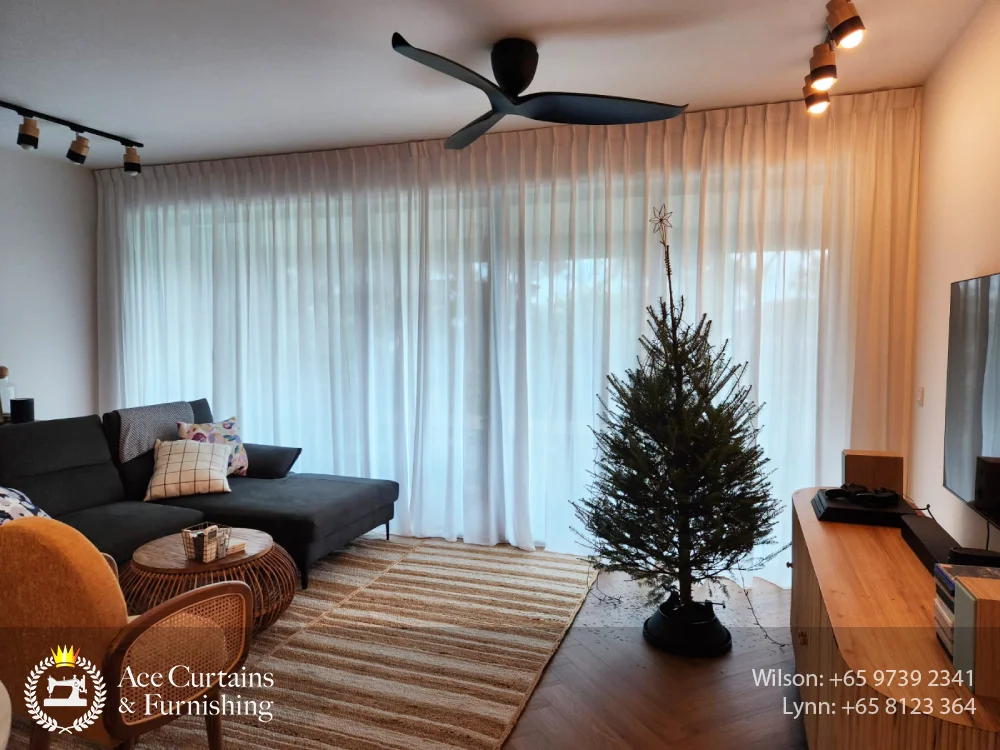
full width living room day curtains

A good set of sheer day curtains can significantly block out harsh sunlight & UV rays which creates high thermal energy (heat) in your home, while still letting light into your home.

It is the least costly curtain option to have for blocking out heat. But it will not be highly effectively when the sun is glaring since it is not opaque and is thin.

Night Curtains & Blackout Curtains

living room blackout night curtains installed under pelmet

Blackout curtains use tightly woven fabrics and/or special backings to block 95–100% of external light.

Our standard dimout night curtains and blackout curtains fabric are thick and opaque enough to block out glaring sun. And the thick fabric will prevent some levels of humidity from seeping through into your home.

Layering day and night or blackout curtains might cost more but it will be the best option in your home as it will give you the control when different needs arises.

Thermal‑Lined Curtains

Adding a thermal insulation layer onto your night curtains or blackout curtains can make it:

  • Thicker – creates a better barrier for heat & humidity
  • Darker – reduce sunlight radiation

This is ideal for west‑facing bedrooms, living rooms and high‑exposure stairwells as it keeps your room cooler, reducing the use of aircon and your electricity bills.

Curtains for West‑Facing Windows in Singapore

As mentioned in the beginning, the west sun hits harder in our concrete homes. West-facing rooms sometimes will require more heat reducing solutions if you want to reduce heat in a Singapore home.

Fabric and Colour Recommendations

We recommend you to opt for:

  • Dimout or blackout fabrics in a west-facing room. To block out harsh sunlight, have light control and have thermal protection
  • Use our high quality polyester or polyester-blend fabrics which is highly effective in moisture and heat resistance
  • They also do not fade easily upon a few years of sun exposure.
  • Pick light or neutral colours on the window side to reflect sunlight more effectively than dark fabric

Curtains vs Window Film – Which Works Better?

Singapore homeowners often compare curtains with window films for heat control. Good news is, we provide both and we encourage you to have both installed if you want to keep heat down in your home.

Window Film Strengths

Remsafe cable lock with opaque frosted window film protects privacy.

  • Solar films will reflect the sun’s radiation and reduce the greenhouse effect in your home
  • The reduced greenhouse effect means that it will significantly slow down the trapped solar energy in a room, thus keeping your room cool and it’s highly recommended if you notice that sun is always coming through your windows or have large window panels
  • The solar film will also always be “on” so you don’t have to do anything to operate it

Curtain Strengths

heat treated blackout curtains

  • Curtains provide you with adjustable light control and home privacy throughout the day unlike solar films
  • If you choose to open your windows during the day for fresh air, you can still have your curtains for privacy (unless there’s huge winds)
  • The thick fabric of curtains can also add a layer of light sound insulation

Our Recommended Best Approach in Singapore Homes & Offices

We recommend a combination of both solar film and curtains in Singapore.

You can use window film to create a baseline of heat and UV blocking, slowing the greenhouse effect in your home. Then make use of curtains to create additional barriers to it – while accentuating your room with a luxury look.

If you have limited budget, we recommend a single layer of night curtains. Otherwise, layering day and night curtains will be the best approach.

Tips for Maximum Heat Reduction with Curtains

two sets of day and night curtains for bedroom

1. Mount Curtains Close To Windows, Full Length & Full Width

  • Our installation team will always try to mount our curtains as close to your windows as possible. However, always make sure to confirm with your curtains company on this
  • Making sure to have full length and width curtains will reduce all the gaps where hot air and humidity can seep through or leak in

2. Keep Your Curtains Closed Before PEAK Heat

  • Close your windows (especially if it has solar film on it) and your curtains before the hottest time of the day. This will prevent your surfaces and room from heating up
  • Then open up your windows and curtains when it’s cooler to release any trapped heat and let fresh air in

3. Choose the Right Fabric for Your Home

  • Use polyester or polyester-blend fabrics to handle the heat and humidity in Singapore. Since it is less prone to sun damage and also moisture resistant

4. Combine Curtains with Other Solutions

We haven’t talked about this but getting a dehumidifier will also significantly help with the heat in your home. When humidity is high in Singapore, you will feel sticky and unable to cool down even when the fan is turned on.

An aircon works like a dehumidifier but it comes with higher electricity bill. We recommend getting dehumidifiers in your home draw in moist air for you.

And combining it with window curtains and solar films for the maximum cooling effect.

Conclusion: Effectively Reduce Heat With Curtains

Investing in the right curtains is one of the most practical and affordable ways to reduce heat in your Singapore home.

For most HDB flats and condos, prioritise blackout or thermal curtains on your sunniest windows, pair them with lighter fabrics elsewhere. You should also combine curtains with good habits like closing them during peak afternoon heat, and consider layering with window solar film for even better results in very exposed units.

Ready to upgrade? Visit our custom curtains collection page to explore heat-reducing options tailored for Singapore’s climate. Check the fabric guide for material recommendations and our cost guide to see how affordable staying cool can be. Your cooler home is just a smart curtain choice away.

Living in Singapore, we all face the same problem. Your home starts feeling like a greenhouse by late afternoon. And the only quick fix would be to turn on your aircon. BUT! The good news is that with the right curtains, you can significantly reduce heat and keep your home cooler while lowering energy usage.

This guide will explain why Singapore homes trap heat, how curtains can reduce heat and what types of fabric work best for our hot weather.

Why Singapore Homes Trap Heat

1. West Sun and Strong Solar Gain

full width living room day curtains

According to Energy Market Authority, Singapore is one of the most solar-dense cities in the world. Being located close to the equator, we experience high solar radiation and high humidity. When late-afternoon sun hits between 3pm to 7pm, it creates an intense cumulative heat.

2. Concrete Heat Retention

With our housing walls being made with concrete, which is a poor to moderate conductor of it, it absorbs, stores and radiates heat over time.

In the early to mid afternoon, our homes would feel cooling because the concrete has had time to cool down over the night before the sun comes up again. This helps to cool down the room. Over the day, the concrete walls start to absorb the heat.

By evening, your walls would have gathered the heat so your room will continue to stay warm while releasing the heat. This is why your home still feels hot long after sunset. Combine this with high levels of humidity, you would feel hot and stuffy even when the temperature outside of your home has dropped.

Curtains that block or reflect sun through your windows especially when you have large window panes can interrupt this heat absorption and help reduce heat in your home more effectively.

3. High‑Rise, Windows & Area

High-rise buildings, large window panels, and living near large body of water are factors that can affect the heat in your home.

Living in high-rise HDB or condo unit can expose your home to direct solar radiation and also heat transfer from the roof if you are living on the top floor. You may also think that it would be windy living at higher levels, but be ware that the winds that enter could also be hot because hot air rises. And your home would be dusty.

Large window panes can give you a stunning view but it also increases the area where heat can enter. Without proper shading, the windows can turn your home into a greenhouse.

Living near large body of water will also add to the heat you feel in your home. When there is water, there will be higher humidity because there’ll always be moisture in the air due to evaporation.

Do Curtains Actually Reduce Heat?

Yes. When you choose the right type of curtains, they can act as a thermal layer at your windows.

How Curtains Work as Thermal Barriers

living room privacy day curtains

Curtains add an extra insulating layer of air between your windows and your room.

Even a layer of day curtain can block out UV rays which will significantly reduce heat in your room.

With thick night curtains or blackout curtains, you reduce the greenhouse effect in your room through your windows by blockout out sunlight’s heat radiation and also the UV rays.

Best Cost-Effective Curtain Types for Heat Reduction

Not all curtains are created equal to reduce heat in a Singapore home. Some are more effective than other and some are more costly than others.

Day Curtains

full width living room day curtains

A good set of sheer day curtains can significantly block out harsh sunlight & UV rays which creates high thermal energy (heat) in your home, while still letting light into your home.

It is the least costly curtain option to have for blocking out heat. But it will not be highly effectively when the sun is glaring since it is not opaque and is thin.

Night Curtains & Blackout Curtains

living room blackout night curtains installed under pelmet

Blackout curtains use tightly woven fabrics and/or special backings to block 95–100% of external light.

Our standard dimout night curtains and blackout curtains fabric are thick and opaque enough to block out glaring sun. And the thick fabric will prevent some levels of humidity from seeping through into your home.

Layering day and night or blackout curtains might cost more but it will be the best option in your home as it will give you the control when different needs arises.

Thermal‑Lined Curtains

Adding a thermal insulation layer onto your night curtains or blackout curtains can make it:

  • Thicker – creates a better barrier for heat & humidity
  • Darker – reduce sunlight radiation

This is ideal for west‑facing bedrooms, living rooms and high‑exposure stairwells as it keeps your room cooler, reducing the use of aircon and your electricity bills.

Curtains for West‑Facing Windows in Singapore

As mentioned in the beginning, the west sun hits harder in our concrete homes. West-facing rooms sometimes will require more heat reducing solutions if you want to reduce heat in a Singapore home.

Fabric and Colour Recommendations

We recommend you to opt for:

  • Dimout or blackout fabrics in a west-facing room. To block out harsh sunlight, have light control and have thermal protection
  • Use our high quality polyester or polyester-blend fabrics which is highly effective in moisture and heat resistance
  • They also do not fade easily upon a few years of sun exposure.
  • Pick light or neutral colours on the window side to reflect sunlight more effectively than dark fabric

Curtains vs Window Film – Which Works Better?

Singapore homeowners often compare curtains with window films for heat control. Good news is, we provide both and we encourage you to have both installed if you want to keep heat down in your home.

Window Film Strengths

Remsafe cable lock with opaque frosted window film protects privacy.

  • Solar films will reflect the sun’s radiation and reduce the greenhouse effect in your home
  • The reduced greenhouse effect means that it will significantly slow down the trapped solar energy in a room, thus keeping your room cool and it’s highly recommended if you notice that sun is always coming through your windows or have large window panels
  • The solar film will also always be “on” so you don’t have to do anything to operate it

Curtain Strengths

heat treated blackout curtains

  • Curtains provide you with adjustable light control and home privacy throughout the day unlike solar films
  • If you choose to open your windows during the day for fresh air, you can still have your curtains for privacy (unless there’s huge winds)
  • The thick fabric of curtains can also add a layer of light sound insulation

Our Recommended Best Approach in Singapore Homes & Offices

We recommend a combination of both solar film and curtains in Singapore.

You can use window film to create a baseline of heat and UV blocking, slowing the greenhouse effect in your home. Then make use of curtains to create additional barriers to it – while accentuating your room with a luxury look.

If you have limited budget, we recommend a single layer of night curtains. Otherwise, layering day and night curtains will be the best approach.

Tips for Maximum Heat Reduction with Curtains

two sets of day and night curtains for bedroom

1. Mount Curtains Close To Windows, Full Length & Full Width

  • Our installation team will always try to mount our curtains as close to your windows as possible. However, always make sure to confirm with your curtains company on this
  • Making sure to have full length and width curtains will reduce all the gaps where hot air and humidity can seep through or leak in

2. Keep Your Curtains Closed Before PEAK Heat

  • Close your windows (especially if it has solar film on it) and your curtains before the hottest time of the day. This will prevent your surfaces and room from heating up
  • Then open up your windows and curtains when it’s cooler to release any trapped heat and let fresh air in

3. Choose the Right Fabric for Your Home

  • Use polyester or polyester-blend fabrics to handle the heat and humidity in Singapore. Since it is less prone to sun damage and also moisture resistant

4. Combine Curtains with Other Solutions

We haven’t talked about this but getting a dehumidifier will also significantly help with the heat in your home. When humidity is high in Singapore, you will feel sticky and unable to cool down even when the fan is turned on.

An aircon works like a dehumidifier but it comes with higher electricity bill. We recommend getting dehumidifiers in your home draw in moist air for you.

And combining it with window curtains and solar films for the maximum cooling effect.

Conclusion: Effectively Reduce Heat With Curtains

Investing in the right curtains is one of the most practical and affordable ways to reduce heat in your Singapore home.

For most HDB flats and condos, prioritise blackout or thermal curtains on your sunniest windows, pair them with lighter fabrics elsewhere. You should also combine curtains with good habits like closing them during peak afternoon heat, and consider layering with window solar film for even better results in very exposed units.

Ready to upgrade? Visit our custom curtains collection page to explore heat-reducing options tailored for Singapore’s climate. Check the fabric guide for material recommendations and our cost guide to see how affordable staying cool can be. Your cooler home is just a smart curtain choice away.

Ace Curtains & Furnishing get a free consultation banner with book now button